
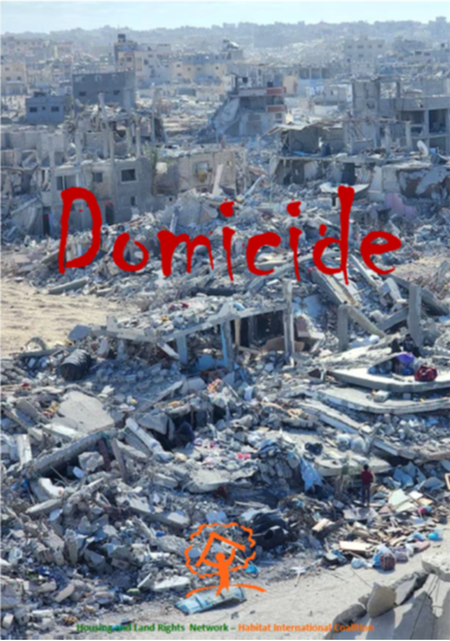
Domicide
The annual World Habitat Day / Urban October report 2026 from the HLRN Violation Database documents the practice of “domicide” — the deliberate, systematic destruction of homes and habitat. This year’s investigation charts the frequency, scale and lethal methods with which domicide is practiced with increasingly widespread deprivation, yet it is still not named as a crime. Drawing on HIC-HLRN`s Housing and Land Rights Violation Database (VDB) since 2015, this 2026 report defines domicide, maps its eight typologies, identifies its structural drivers and proposes a six-tier accountability framework.
The report`s central call is to codify domicide as a standalone crime against humanity and war crime under the Rome Statute, while using existing law now to prosecute perpetrators, deliver reparation to victims and ultimately to end the practice.
Defining domicide and the legal gap
The report adopts the definition advanced by former UN Special Rapporteur on adequate housing Balakrishnan Rajagopal: the deliberate and systematic destruction of homes, rendering them uninhabitable, or the systematic denial of housing, in violation of international law. It covers both physical destruction and functional disruption — destroying water, power, farmland or civil registries, or denying return.
Following Porteous and Smith (2001), domicide spans "everyday" forms (evictions, redevelopment, extraction) and "extreme" forms (bombing, scorched earth). It may be committed by act or by omission, incrementally or en masse.
Existing law already prohibits its components:
- Human rights law: ICESCR Art. 11 (adequate housing) and ICCPR Arts. 9, 10 and 17.
- Humanitarian law: Fourth Geneva Convention Arts. 49, 53 and 147 — but treaties treat housing loss as secondary property damage, not a method of erasing communities.
- Criminal law: Rome Statute Arts. 7 and 8 can reach home destruction, but no named charge directs prosecutors to it.
The VDB holds 1,955 records of housing, land and property violations, with an aggregate victim count above 1.22 billion people. Entries peaked in 2020 (88 records), but victim numbers are highest in 2023–26, driven by Palestine, Ukraine and Sudan. The report sorts cases into eight typologies:
Typology and emblematic cases since 2015
1. Armed violence and active conflict: Ukraine (13.6 million affected; Mariupol, Kakhovka Dam); Sudan (10.7 million); Lebanon (~290,000–300,000 housing units
damaged or destroyed since Oct 2023); Yemen (4 million IDPs); Rohingya in Myanmar.
2. Latent conflict and protracted crisis: Sudan: civil war layered on Darfur displacement, dam projects and climate-driven drought and flooding.
3. Market, corporate and state land capture: Asia leads with 32.5 million displaced; Shanghai redevelopment (est. 3 million+ relocated); Baku.
4. Occupation, colonization and population transfer: Historic Palestine (16.6 million documented victims since 1917; ~9.7 million refugees and descendants); Western Sahara; Tibet; Kashmir; southern Lebanon
5. Ethnic cleansing and demographic engineering: Nagorno-Karabakh (entire Armenian population expelled in 2023); Naqab villages (al-`Araqib demolished 244 times); Uyghurs (3 million)
6. Punitive and persecutory action: India`s "bulldozer justice" against Muslim homes; ICE raids on homes in the USA ("Midway Blitz", Chicago, 2025)
7. Infrastructure development: Three Gorges Dam (~4 million); Shandong village clearance (5 million); Jeddah (558,000+) and Neom, Saudi Arabia
8. Genocide: Gaza: an estimated 82% of buildings destroyed, affecting 2.3 million residents, with AI-assisted targeting of homes
Domicide is a composite crime. Each case triggers a cascade of violations — of the rights to life, health, water, food, education, work, culture and identity documents. Five VDB cases combine all five monitored violation types (eviction, destruction, dispossession, privatization, environmental harm), the largest being the Philippines "Flooded by Corruption" case (2.7 million victims).
Structural drivers and impunity
Domicide is not random. The report traces it to recurring drivers:
- Racism, religion and nationalism — targeting groups by identity to achieve demographic homogeneity.
- Patriarchy — women without male title-holders are evicted and excluded from compensation; displaced women face sharply higher maternal-health risks.
- Competition over resources — oil, minerals, water, farmland and, increasingly, tourism and short-term rentals (Benin, Cádiz, Madrid).
- "Green" relocation — climate adaptation and conservation schemes used to justify forced evictions.
Impunity is total. Across all 1,955 VDB records, no perpetrator has been held fully accountable for domicide, and no victims have received remedy under the UN remedy and reparations framework. ICC convictions touching on home destruction (Katanga, Al Mahdi, Ntaganda, Ongwen) treated it as incidental to other charges.
Six tiers of accountability
Responsibility extends well beyond the hand that demolishes:
1. Sovereign governments — primary duty holders; must prevent demolitions and legislate remedy.
2. Non-state combatants — chargeable under IHL (Additional Protocol I) and the Rome Statute.
3. Corporations and other enterprises — developers, extractive firms, mega-project consortia and "charities" that fund domicide, such as parastatal bodies registered abroad.
4. Multilateral institutions — the World Bank, IMF, development banks and climate funds bear independent responsibility under the ILC`s 2011 Articles on the Responsibility of International Organizations.
5. Third states — extraterritorial obligations bar supplying arms, finance or support used in domicide.
6. Individuals — the ICC can already try commanders, officials and accomplices for home destruction under Arts. 7 and 8; the gap is the lack of a named charge, not of jurisdiction.
Priority recommendations
Governments should criminalize domicide in domestic law, create national investigation commissions, impose immediate moratoriums on demolitions and forced evictions, ban wide-area weapons and AI targeting in populated areas, incorporate the UN reparations framework, ratify the Optional Protocol to the ICESCR, and recognize customary land tenure.
Third states and multilateral institutions should suspend arms transfers under Common Article 1 of the Geneva Conventions, apply sanctions and divestment, make lending conditional on housing, land and property rights assessments, and empower regional human rights bodies to issue emergency injunctions.
The UN should adopt a General Assembly resolution defining domicide ahead of Rome Statute amendment; the Security Council should refer ongoing situations (Palestine, Lebanon, Sudan, Ukraine, Myanmar) to the ICC; the Human Rights Council should create a Special Procedure on domicide; and the CESCR should issue a General Comment on it.
Civil society should expand the VDB into a Global Domicide Documentation Consortium producing ICC-ready evidence, defend housing rights defenders and pursue strategic litigation.
Resourcing remedy: escrow funds financed by fines, seized assets of liable states and enterprises, and the ICC Trust Fund for Victims should channel resources directly to affected communities through the social production of habitat, with household-level measurement of both material and non-economic loss.
Conclusion
Domicide is neither accidental nor natural: It is an organized instrument of destruction and capital accumulation, enabled by state action and inaction and sustained by impunity. The duty holders are identifiable and the legal tools largely exist. What is missing is political will, a named crime and remedy that is as structural as the harm — and a recognition that consumers and financiers everywhere may be subsidizing the destruction of other people`s homes.
Download Domicide
Image: Cover of HLRN publication Domicide.
Download