
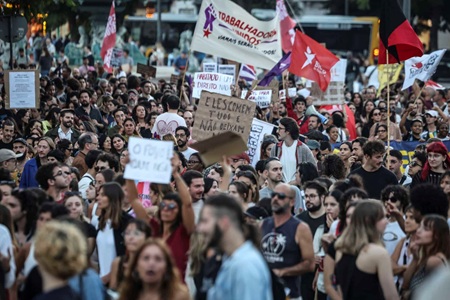
Thousands protest in Portugal over rising living and housing costs
Demonstrations in Lisbon, Porto and other cities highlight growing frustration over wages, housing affordability and the cost of everyday life
Thousands of people took to the streets of Lisbon and Porto on Saturday, 10 October to protest against the rising cost of living, unaffordable housing and wages that they say are insufficient to meet basic needs.
The demonstrations were organised by the platform “Não dá mais para viver assim” (We can’t go on living like this), which also called protests in Aveiro and Braga.
In Lisbon, crowds gathered at Largo do Intendente, where people of different ages assembled to express their frustration over the increasing financial pressures facing households.
According to Correio da Manhã, the square was already packed shortly before the scheduled start of the demonstration, with protesters highlighting the difficulties of making ends meet.
“The salary is not enough to live on” was one of the central messages of the protests, reflecting concerns about the growing gap between earnings and everyday expenses.
Housing affordability was another major issue, particularly in cities such as Lisbon and Porto, where high rents and property prices have made it increasingly difficult for many residents to find suitable accommodation.
The demonstrations brought renewed attention to the pressures facing working people, young adults and families struggling to balance housing costs with other essential expenses.
According to Público, protesters also referred to similar struggles in neighbouring Spain, highlighting the wider concerns about housing affordability and living standards across the Iberian Peninsula.
The protests reflect mounting frustration over the cost of everyday life in Portugal, where housing has become one of the country’s most pressing social and political issues.
For those taking part, the message was that having a job should provide enough income to afford a home and maintain a reasonable standard of living.
The demonstrations placed renewed pressure on political leaders to address the difficulties faced by households whose incomes are failing to keep pace with their living expenses.
José Manuel Pureza, of the Left Bloc (Bloco de Esquerda), also attended the protest. According to Público, he warned that “more and more people are unable to pay their bills, while a small group of people are making astronomical profits”.
Pureza also criticised the government’s proposed 2027 State Budget, submitted to Parliament this week, describing it as a “blank cheque” for the continuation of the current situation and ruling out abstention in the parliamentary vote. He also called for limits on rent increases.
Isabel Mendes Lopes, of the Livre party, was equally critical of the Budget proposal, accusing Prime Minister Luís Montenegro of “living in a bubble” and governing for people like himself rather than the wider Portuguese population.
She particularly criticised the government’s definition of moderate rent, which can extend to €2,300 a month. “To think that a moderate rent can be as high as €2,300 shows a complete disconnect from the real world and the reality in which most people live,” she said, adding that wages in Portugal remain very low and many households struggle to pay their bills at the end of the month.
According to Público, the organisers are calling for price controls on essential goods and fuel, taxes on windfall profits made by major companies in the banking, energy and retail sectors, and measures to tackle the housing crisis. The platform brings together more than 30 organisations, including trade unions and groups campaigning for housing rights, gender equality, racial equality, climate action and social inclusion.
Sources: Correio da Manhã/Público
Photo: Protesters take part in a demonstration against the rising cost of living and housing crisis in Lisbon on 10 October 2026. Source: Manuel de Almeida/Lusa.