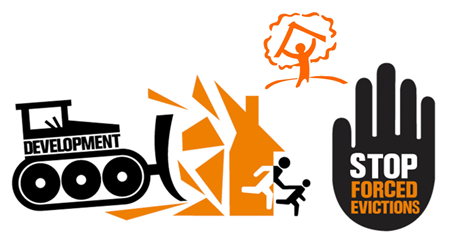
“Securing Homes, Ensuring Rights: A Call to Action against Forced Evictions”
As we commemorate World Habitat Day 2026, Habitat International Coalition (HIC) reaffirms its commitment to advocating for fundamental human rights, including secure land tenure, affordable and decent housing, and access to economic empowerment. Today, we face the grim reality that millions continue to lose their homes due to forced evictions, actions that cannot be dismissed as mere consequences of urbanisation or climate crises, but are a direct result of political choices that prioritise economic gain over human dignity.
Understanding the crisis of forced evictions
Forced evictions occur when individuals and communities are removed from their homes or land without appropriate legal protections, constituting grave violations of international human rights law. It is crucial to recognise that:
- Prevention is feasible. Forced evictions are not inevitable, they stem from policy decisions that can be altered. With the right political will and social accountability, they can be prevented.
- Disproportionate impact on vulnerable communities. The most vulnerable populations, including those defined by gender, race, class and tenure status, are at the highest risk. Attention must be directed toward their protection.
- Legal frameworks matter. Not all legally sanctioned evictions align with human rights standards. The financialisation of housing, profit-driven models of urban development and the failure to regulate private actors are pushing millions of families out of their homes and territories. Justice systems that interpret the law through the lens of property as a market asset, rather than as a human right, further compound these violations, to the detriment of the legitimate needs of the people. It is imperative to ensure that the rights of tenants and occupants are safeguarded above market interests.
Collective responsibility for accountability
The responsibility to prevent forced evictions lies with multiple stakeholders:
States have binding obligations under international human rights law to safeguard housing rights, enforce regulations against forced evictions, and guarantee access to justice for affected individuals.
Private sector actors, including developers, financial institutions and entities within the housing market, must adhere to established human rights standards, ensuring their actions do not contribute to any kind of forced eviction and actively working to remedy harm when it occurs.
Communities affected by forced evictions are not merely victims. They bring invaluable perspectives, knowledge and expertise. Their voices must be elevated in all dialogues around rights and solutions.
Drivers of forced evictions
The widespread issue of forced evictions results from a series of interconnected factors:
- Financialisation of housing. Economic models that emphasise profit over social equity create speculative markets that undermine access to housing for millions of people.
- Climate displacement. Inadequate responses to environmental challenges often exacerbate vulnerability — displacing rather than protecting at-risk populations.
- Structural inequities. Long-standing societal inequalities continuously push marginalised communities into precarious living situations.
Another driver of forced eviction: Inadequate legal protections
Weak legal frameworks fail to provide sufficient safeguards against eviction, allowing unjust displacements to persist.
Although governments have committed, under international human rights law and the New Urban Agenda, to prevent and remedy forced evictions, accountability remains limited and the true scale of the problem stays largely invisible. The voices of those most affected are absent from the spaces where decisions are made.
Many of these evictions can be prevented through the application and articulation of laws, legal instruments and public policies that protect habitat. There are experiences that can be replicated and strengthened, both for popular neighbourhoods and for situations involving individual or collective housing. These include the protection of the family home; the regularisation and administrative prescription of properties in favour of their inhabitants; the recognition of the right to purchase, pre-emption or acquisition in foreclosure situations; state support for adverse possession processes and title regularisation; and the regulation and protection of rental housing. Public intervention for housing improvement is also indispensable when risks arise from deficient installations, structural problems, uninhabitable conditions or environmental impacts. These tools make it possible to act before housing loss occurs, and to build alternatives that prioritise permanence, legal security and the right to habitat.
These policies can be complemented by legal advice and interdisciplinary teams for intervention in housing conflicts; mediation and negotiation mechanisms between parties; neighbourhood centres for access to justice; legal assistance to resolve inheritance disputes and undivided estates; and credits or subsidies to cover the costs of title regularisation, inheritance proceedings or the acquisition of properties occupied by families. The goal is to build a network of legal, social, technical and economic tools capable of intervening at an early stage and preventing conflicts from culminating in the loss of a home.
Advocating community-centred solutions
Addressing forced evictions requires a proactive approach that includes:
Thorough evaluation of alternatives. Evictions should only occur following the exhaustive exploration of all alternatives. When unavoidable, affected individuals deserve restitution, resettlement options and equitable compensation.
Comprehensive data collection. To effectively combat forced evictions, it is essential to understand their scope, causes and conditions. Community-led documentation efforts can illuminate previously hidden or invisible displacements.
A call to action
As we mark World Habitat Month this October, HIC calls upon its members, partners and allies to join in raising awareness about forced evictions and championing the right to adequate housing:
- Share your stories. Highlight the lived experiences of those impacted by forced evictions and advocate for initiatives that promote access to affordable housing.
- Engage in meaningful dialogue. Participate in discussions that prioritise housing rights and elevate community-led solutions to prevent evictions.
- Stand united. Join the global call to ensure that no one is deprived of their home — and that accountability for forced evictions becomes a non-negotiable standard.
Together, as we commemorate World Habitat Day 2026, let us renew our commitment to ensuring that every individual has the right to a secure and decent home. Together, we can dismantle the structures that perpetuate forced evictions and create just, inclusive cities that honour the right to housing for all.
Grace Chikumo
President, Habitat International Coalition (HIC)
Guillermo Javier Marzioni
HIC Vice President
| Themes |
| • Communication and dissemination • Displaced • Displacement • Forced evictions • International • Norms and standards • Reparations / restitution of rights • UN system |